A couple of times a year, parents and teachers from all over the country meet to discuss their student’s current performance in their role as student and classmate. This is a wonderful opportunity to partner together to ensure a positive and well-rounded educational experience.
To maximize this parent-teacher time together, I have created a Parent-Teacher conference form. I will walk you through it step by step then you can download this form for FREE below. As a parent, I like to print this out and fill out the parent sections ahead of time. This helps me prepare for the conference.
Note: Use one page or all three pages. The first page is sufficient for most teacher conferences. Pages two and three are helpful when specific challenges arise and a plan is needed.

Page One
- Step One: Enter the Student’s Name, Parent’s Name, Teacher’s Name, and the Date
- Step Two: Start with strengths. Tell the teacher what you love about your kid and ask them what they love. Keep in mind that these strengths support the student’s success and can be utilized in creating a plan to address concerns/obstacles. *If your child has psychoeducational testing, read the report again and highlight or list ALL the average and above-average findings.
- Step Three: Consider your desired goal or outcome for this educational experience. You may have high academic expectations or you may just want your child to love going to school. You may be worried about prioritizing relationships and social growth right now or you may be looking ahead to high school recommendations. Share your hopes with the teacher.
- Step 4: Write down what is going well right now and next to that, write down any concerns you have (i.e., lunch :), socializing at recess, a specific subject).
- If your conference is short, that might be all the time you have. Be sure to find out the best way to communicate with the teacher and how frequently. If you ran out of time and want more time, set up that meeting right now!

Page Two
This page is designed for use when the parent or teacher has concerns related to academics or behaviors
- Section One: List specific concerns then consider what obstacle, hurdle, or specific behavior is standing in the way. Ex: Child is getting a poor grade in spelling because they cannot finish the spelling test on time. Concern: spelling grade; Obstacle: unable to finish on time/keep up with class during spelling test
- Section Two: If you have had psychoeducational or other testing, can this concern be explained by a test finding? Ex: Concern is finishing spelling test on time; Test finding: Dysgraphia diagnosis. This child struggles with written word expression.
- Section Three: If the conversation is about the child’s ability to act/behave in a way that supports learning and relationships with classmates, talk about specifics. Try to capture what your child is doing that isn’t working in this environment. Ex: When the class is lined up and your child is unexpectedly touched, he/she reacts with pushing. Now, talk about what works in these situations and what doesn’t work in these situations. Ex: When my child stands at the beginning or end of the line, he/she isn’t exposed to as much unexpected touch. That might work! Ex: When my child reacts with pushing and I get loud and scold him/her, that seems to escalate the situation. That doesn’t work.
- Section Four: If your child is struggling academically and there is no history of specific learning challenges, use this section to capture the academic area in question and get clear about the expected standard/outcome. This exercise can help you and the teacher get on the same page and generate some ideas for support. Ex: Your child has a failing grade in math because they are not turning in their homework and now have a bunch of zeros. The expected standard is that the math worksheet is placed on the teacher’s desk or submitted electronically at the beginning of every class period.
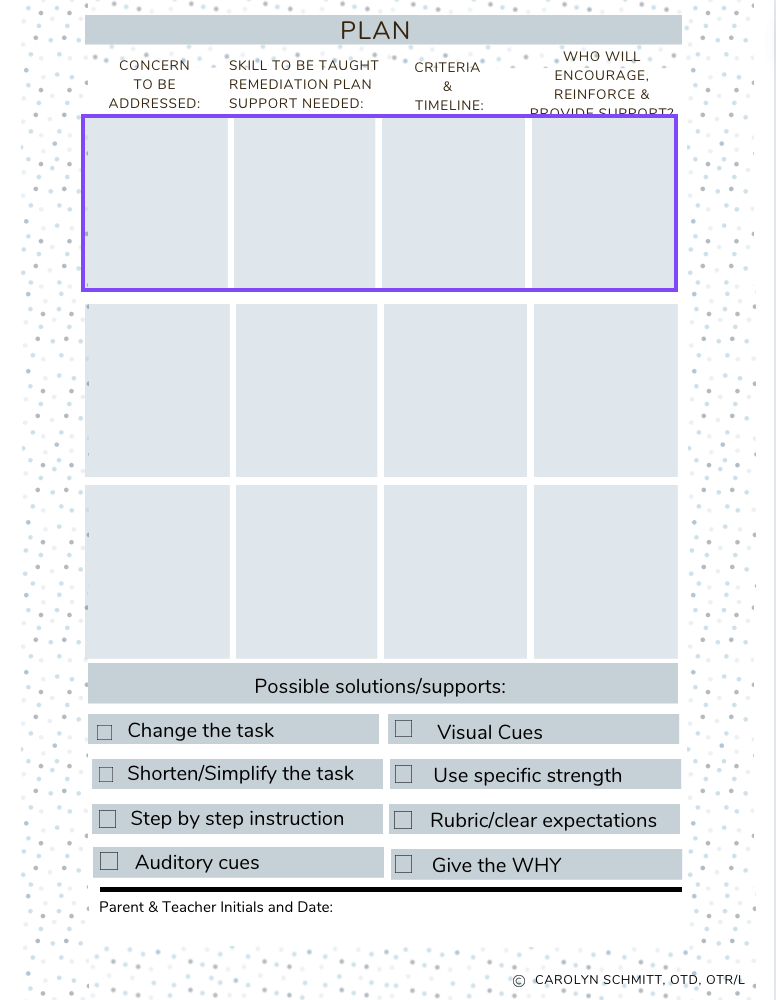
Page 3
This page was designed when a specific plan would be supportive of progress.
- Plan part one: List the specific concerns. Ex: Homework is not being handed in resulting in zeroes.
- Plan part two: What skill needs to be taught, remediated, or what support needs to be given? Ex: Homework needs to be submitted to the teacher on a daily basis (M-F).
- Plan part three: What are the criteria for success (how will we know this is accomplished?) and When do we expect this to be accomplished? Ex: Homework is handed in 5/5 days next week.
- Plan part 4: Who is responsible for encouragement, reinforcement, or support? Parent: remind child daily; Teacher: offer a verbal prompt to all students every day next week.
- Bottom of the page: Here are some possible solutions or supports to be implemented. Boxes checked: Auditory cues; Give the WHY (hand your homework in or you will have a zero).